Sacrificing the Few to Save the Many
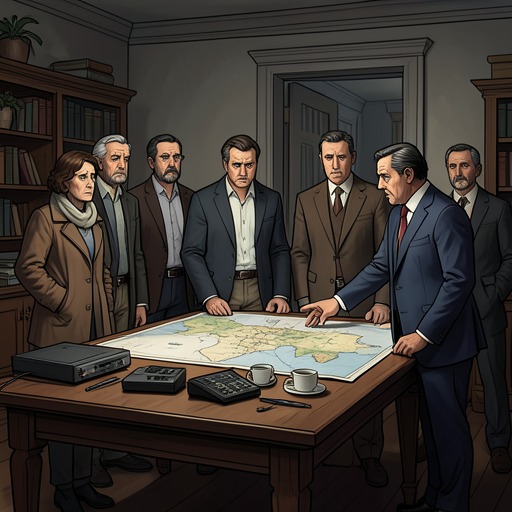
Deception PointSacrificing the Few to Save the Many is the maxim William Pickering uses to frame lethal choices as necessary costs of protecting a larger public or institution. In the novel, its force lies in the gap between an abstract promise of collective safety and the people made expendable in its name: Pickering’s final appeal to national-security sacrifice confronts Rachel Sexton with the immediate consequences of his decisions.
Meaning and Application
The maxim appears in Latin as Iactura paucourm serva multos, which Pickering identifies as a familiar saying in national-security circles. He invokes it while confronting Rachel and Michael Tolland aboard the Goya, presenting casualties as an unavoidable feature of war and asking Rachel to understand the logic behind his choices. Rachel’s reply makes that logic personal: she recognizes that Pickering has placed her and Michael among the few he is prepared to sacrifice.
The phrase does not stand apart from the plot as a general ethical slogan. Pickering has admitted that the meteorite deception originated in fear and says the plan was meant to save an important government agency, not to cause deaths. His appeal to the greater good therefore accompanies a scheme whose consequences have exceeded its stated purpose. The maxim gives those consequences a justification, but Rachel’s resistance exposes the moral cost hidden by the language of necessity.
The Logic of the Few
The novel places the maxim beside several distinct forms of violence and concealment. Delta-One recalls assignments that included covert killings, and on the Milne Ice Shelf he carries out a plan to kill four members of the investigation party and make their deaths appear to result from exposure and hypothermia. The operational aim is not merely to eliminate witnesses but to disguise the deaths, turning murder into an apparent consequence of dangerous conditions.
That violence is part of the wider effort to protect a classified intelligence capability. Pickering explains that he had spearheaded the development of a deep-diving submarine so the National Reconnaissance Office could extend its hydrophones into the Mariana Trench, where enemy saboteurs could not reach them. The covert operation uncovered geological structures, chondrules, and fossils, but the classified nature of the mission prevented the discoveries from being shared openly. The meteorite deception grew from the collision between these secret findings and the desire to protect the agency and its work.
The maxim’s logic also reaches into political calculation. Marjorie Tench and Lawrence Ekstrom conspired over the PODS lie in the hope that a limited success would help President Zachary Herney resist Sedgewick Sexton’s rising campaign. Pickering believes Tench’s investigation into Rachel’s accusations would expose the fraud, and he regards her death as a consequence that could not be avoided once she pursued the truth. He further recognizes that her death could benefit the White House politically by generating sympathy and casting suspicion on Sexton’s campaign. In this instance, the language of sacrifice overlays institutional self-preservation and political advantage.
Rachel’s Refusal and Pickering’s Choice
Rachel encounters the maxim not as a distant principle but while trying to survive the attack on the ice. Although exhausted and in severe pain, she makes herself sit up and repeatedly drives the butt of her ice ax into the ice, attempting to signal for help. Her action stands in contrast to the attackers’ treatment of the investigators as manageable losses: Rachel continues to act, and to seek a way to save others, even when she believes the truth may remain beyond her reach.
Aboard the Goya, Pickering’s maxim becomes an explicit justification for the imminent threat to Rachel and Michael. He says that war involves casualties and cites the deaths of people who have defended the nation, then appeals to the principle of saving the many by sacrificing the few. Rachel rejects the framing by naming the two people the calculation has put at risk. When Pickering considers her challenge, he orders Delta-One to release his partner and end the confrontation. The decision interrupts the logic of their planned sacrifice: Pickering does not simply repeat the maxim but acts against the course it had appeared to authorize.
Thematic Significance
The maxim connects the novel’s covert methods to its central moral conflict over who may claim authority to define the public good. Pickering’s operations depend on secrecy, and their defenders treat the risks and losses as costs that can be managed for the sake of national security. Yet the same secrecy deprives the people being endangered of knowledge, consent, and any meaningful chance to judge the claimed necessity for themselves.
The phrase’s apparent simplicity is also its danger. It converts a decision about particular lives into a clean numerical contrast between the few and the many. The novel complicates that arithmetic by showing that purportedly collective protection can serve an agency’s survival and a political campaign, while those sacrificed include witnesses and investigators whose deaths would conceal the truth. Rachel’s direct challenge, followed by Pickering’s order to stand down, leaves the maxim unresolved as a rule: the appeal to necessity may explain a decision, but it does not erase responsibility for making it.